
Hospital for Special Surgery · #1 Ranked Hospital for Orthopedics, U.S. News & World Report|For appointments call (646) 885-5950
Kyle N. Kunze, MD Orthopaedic Sports Medicine Surgeon Cartilage Restoration · Joint Preservation Hip · Knee · Shoulder · Regenerative Medicine
Patient Resources

Tips for Sling Use

Living in a sling makes ordinary tasks unexpectedly difficult. These guides and strategies cover how to dress, sleep, bathe, and move safely while your shoulder heals.

Start Here

The First Weeks in a Sling

Shoulder surgery is unusual in that the recovery limits the arm you use for nearly everything. Immobilization in a sling or brace protects the repair, but it also means dressing, showering, sleeping, and eating all have to be relearned for a period of weeks. Patients are often surprised by how much of early recovery is logistical rather than painful.

Daily Life

Activities of Daily Living

The principle behind all of these strategies is the same: the operative arm stays passive. Let gravity, your other hand, and the furniture around you do the work. Nothing below should require you to actively lift, reach behind your back, or rotate the shoulder outward unless our office has told you otherwise.

Dressing
Put the operative arm into the sleeve first and take it out last. Loose button-front or zip-front shirts are far easier than anything pulled over the head. Avoid pullover tops and sports bras in the early weeks.
Showering and bathing
Most patients shower with the sling off once cleared, keeping the arm resting at the side and letting water run over the shoulder rather than scrubbing it. A handheld shower head, a shower chair, and long-handled sponge make this much easier. Do not submerge the incision until we clear it.
Sleeping
Sleeping flat on your back is uncomfortable for most patients early on. A recliner, or a wedge of pillows that keeps you semi-upright with the elbow supported slightly forward of your body, is generally the best position. Keep the sling on at night as instructed.
Eating and kitchen tasks
Bring the plate to you rather than reaching out to it. Pre-cut food, lightweight cups, and having frequently used items moved to counter height before surgery all reduce frustration substantially.
Desk work and screens
Support the forearm on a pillow or armrest so the shoulder is not carrying the weight of the arm all day. Take the arm out of the sling for brief elbow, wrist, and hand motion as directed — stiffness in those joints is avoidable.
Driving
Do not drive while in the sling or while taking narcotic pain medication. Return to driving is a decision made with our office based on your procedure, your operative side, and your control of the arm.

Video demonstrations

These videos, produced by HSS, walk through the movements patients ask about most in the first weeks. Each one plays here on the page — watching before your surgery date is the best way to prepare.
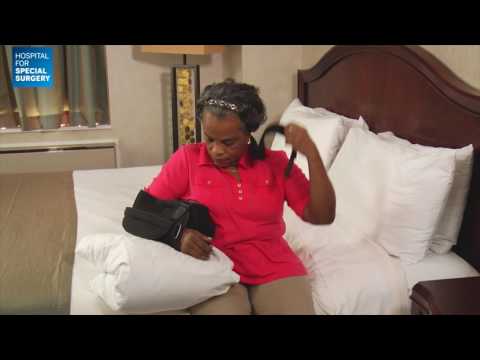
How to Take off your Sling
Having trouble? Watch on YouTube ↗
How to Put on your Sling
Having trouble? Watch on YouTube ↗
How to Put on a Shirt
Having trouble? Watch on YouTube ↗
How to Take off a Shirt
Having trouble? Watch on YouTube ↗
How to Get out of Bed
Having trouble? Watch on YouTube ↗
Further Reading

HSS Shoulder Replacement Resources

Please review the following HSS guides for shoulder replacement, which include a comprehensive overview of what the surgical experience will be like, precautions and positions after surgery, rehabilitation exercises, and tips for performing activities of daily living after surgery. These resources are customized specifically to right and left shoulder replacement.

Questions About Your Recovery?

Postoperative concerns are always welcome — call our office.

Contact Our Office